There is a moment most competitive soccer parents know well.
Something has happened. Maybe it is playing time that does not make sense. Maybe it is something your kid came home and told you that you cannot stop thinking about. Maybe it is a pattern you have been watching for weeks that nobody else seems to notice or care about.
You know you need to say something. You also know that the coach controls your kid’s playing time, their confidence on the team, their development trajectory. And you have watched what happens when parents approach coaches the wrong way.
So you wait. And it keeps building.
When you finally decide to say something, you walk in with everything you have been carrying — the frustration, the replayed moments, the things you wish had gone differently — and you lead with all of it.
That is the mistake.
Not the approaching. Not the advocating. Not the decision to say something. The leading with the complaint.
Here is why it matters — and what to do instead.
Why Leading With a Complaint Backfires
When a parent opens a coach conversation with what they are unhappy about, something predictable happens. The coach goes into a defensive position immediately. They are bracing for an accusation. They are thinking about how to justify their decisions. And the conversation becomes adversarial before it has a chance to become productive.
You came in to advocate for your kid. You end up in a debate about whether your read on the situation is even accurate.
That is not a conversation that helps your child.
The coach’s defensive response is not weakness or bad faith. It is a natural human reaction to feeling criticized. And it happens regardless of how legitimate your concern is or how carefully you chose your words. The structure of the conversation — complaint first — triggers it almost every time.
The Move That Changes Everything
The parents who consistently get heard by coaches do something different. They lead with their kid, not their complaint.
It sounds like a small shift. It is not.
“I want to make sure I am supporting Marco the right way at home, and I would love your perspective on where he is in his development.”
That one sentence does three things simultaneously. It positions you as a partner rather than an opponent. It signals that you respect the coach’s professional view. And it gives the coach an opening to share information — real information — that serves your child.
From that opening, almost anything you actually need to address becomes accessible through questions rather than accusations.
“Is there anything you are seeing in training that I should be reinforcing at home?”
“Is there a reason his role has shifted recently? I want to make sure we are working on the right things.”
These are not confrontational. They are curious. And curious questions get honest answers far more often than complaints get real change.
Before You Walk In
There is one thing to do before any coach conversation that most parents skip — and skipping it is why so many of these conversations end without resolution.
Get specific about what you actually want.
Most parents go in with a feeling. Something is wrong. I am not happy. This needs to change. But a feeling is not a goal. And if you do not have a clear, specific ask before you walk in, you will not walk out with a clear, specific outcome.
Ask yourself this: if this conversation goes perfectly, what is different afterward?
If the answer is I understand why my kid’s playing time looks the way it does, that is an information-gathering conversation. If the answer is I want the coach to adjust how they speak to my child, that is a behavior-change conversation. If the answer is I need the coach to know what is happening at home that is affecting my kid’s focus, that is a context-sharing conversation.
Each one requires a different approach. Knowing which one you are having before you walk in changes everything about how you have it.
Timing and Setup Matter More Than You Think
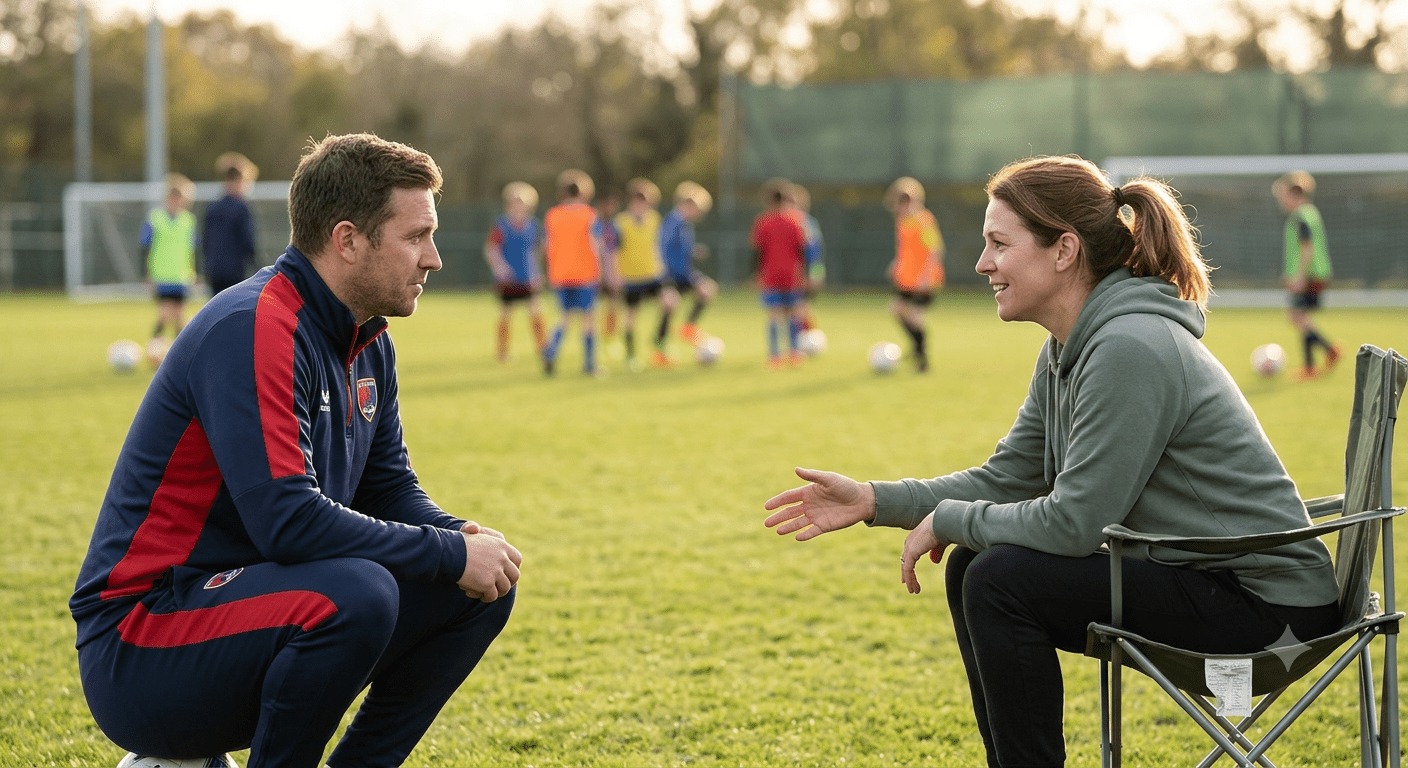
The conversation itself is only part of the equation. How you request it sets the tone before the first word is spoken.
Right after a game is almost never the right time. For either of you. Emotions are high, the coach has fifteen other things to manage, and the conversation will go worse than it would have 48 hours later. The sideline during training is not the right place either — it is public, it is interruptive, and it signals to your kid and their teammates that something is happening.
A private message that says something like — “Coach, I would love to find five minutes to connect when it is convenient for you. Nothing urgent, just want to talk” — does something that showing up unannounced cannot. It gives the coach time to shift into a receptive mindset. And the phrase nothing urgent is doing significant work. It signals you are not in crisis mode. It signals you are not coming in hostile. It makes it easier for the coach to say yes — and to actually show up to the conversation ready to listen.
When You Need to Say the Hard Thing
Sometimes there is something that needs to be named directly. Avoiding it to stay comfortable is how conversations end without resolution — and how the same problem comes back next month and the month after that.
The framing that changes outcomes is saying the hard thing about you, not about them.
Instead of: “I feel like Emma is being treated unfairly.”
Try: “I want to make sure I am not missing something. From where I sit, it looks like Emma’s role on the team has changed. Can you help me understand what you are seeing?”
The first version is a verdict. The second is a question. Verdicts make people defend themselves. Questions make people explain themselves. And explaining is more useful than defending — for everyone in the room, especially your kid.
If what you need to raise is about how your child is being spoken to, the framing is:
“My kid came home after Tuesday’s practice and repeated something they heard that stuck with them. I am not here to make a big deal of it. I just want you to know how it landed so you have the full picture.”
That gives the coach information without backing them into a corner. Most coaches, given information in good faith, will do something with it.
What to Do If It Doesn’t Go Well
Not every coach conversation goes the way you hoped. Knowing that in advance — and knowing what you will do if it doesn’t — is what keeps a difficult conversation from becoming a damaging one.
If the coach is dismissive or defensive, the instinct is to escalate in the moment. Push harder. Say the sharper version of what you came in to say. That almost never works. And it almost always makes things harder for your kid.
What works is an exit that keeps the relationship intact even when the conversation did not go as planned.
“I appreciate you talking with me. I may need to think through some of what you shared. Can I follow up if I have more questions?”
That close does not surrender your position. It does not pretend everything is resolved. It keeps the door open and gives you time to decide your next move without making it in an emotionally charged room.
The Bottom Line
Coach conversations are hard because the stakes are real. You are not negotiating a complaint. You are advocating for your kid inside a relationship where the other person has more institutional power than you do.
That dynamic is uncomfortable. But it is navigable.
The parents who navigate it well almost always do it the same way. They prepare before they go in. They lead with their kid. They ask more than they tell. They name the hard thing without making it an accusation.
They walk in as partners, not adversaries. And most of the time, coaches respond to partners.
Not sure how to handle the specific coach situation you are dealing with right now? Take the free two-minute quiz and get your soccer parent archetype and a direct recommendation for the right tool for your situation.
Trending Products