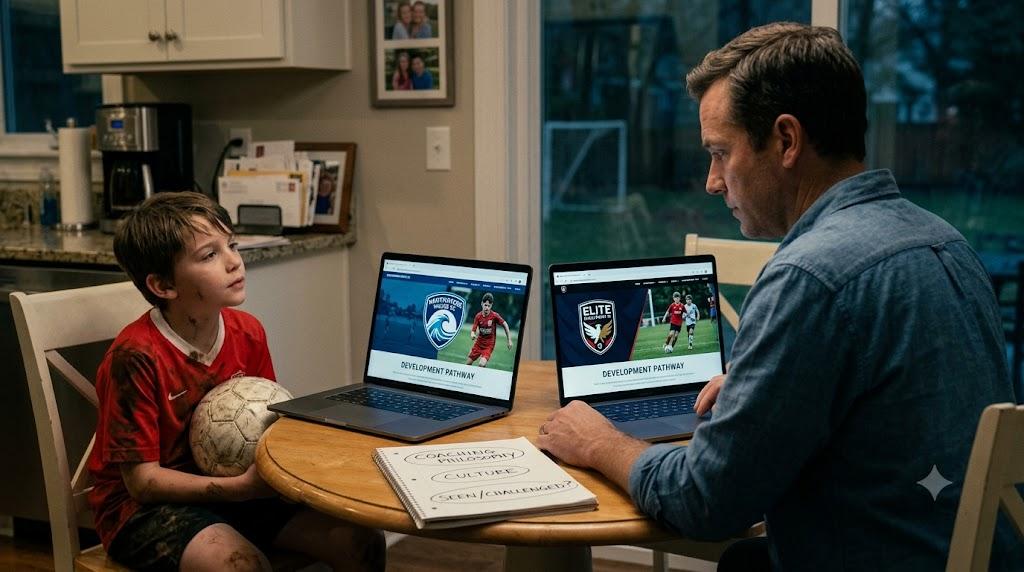
You’re sitting at the kitchen table with two club logos pulled up on your laptop, and somehow this decision has started to feel like it’s about your kid’s entire future.
Is Club A the one with the scouts? Did that kid who went D1 three years ago play for Club B? Does the fancier crest mean the coaching is better, or does it just mean the uniforms cost more?
I get it. The youth soccer industry is very good at making you feel like the club name is the variable that determines everything. It isn’t. And after 17 years inside this world — first as a dad trying to figure it out in real time, then as someone who’s talked to thousands of parents wrestling with this exact decision — I can tell you the club name is one of the least useful signals you have.
Here’s what actually matters, in order.
Does the coaching staff have a development philosophy they can explain in plain language?
Ask a club director this, directly: “How do you develop players at this club?”
Watch what happens next. A good answer sounds specific. Something like “we build out of the back at every age group, even when it costs us games early in the season, because we’re not optimizing for U11 tournament trophies.” That’s a philosophy. That’s someone who’s thought about this.
A bad answer pivots. It slides into tournament record, alumni who went on to play in college, how many teams the club fields, how “competitive” the environment is. None of that is a development philosophy. It’s marketing. And if a club can’t tell you how they develop players — only that they do — that’s information you should weigh heavily.
This is the single highest-leverage question you can ask during a club evaluation, and most parents never ask it directly. They infer the answer from reputation instead of just asking.
Is your child challenged and seen — and are those actually the same thing at this club?
Challenged and seen are two different things, and a lot of high-profile clubs are great at one and quiet about the other.
Challenged means the training environment is hard enough to produce real growth — technically, tactically, physically. That’s usually visible. You can watch a training session and get a read on the intensity and quality of the coaching.
Seen is harder to spot from the sideline. It means someone on staff actually notices when your specific kid is struggling — not just whether they’re winning their individual battles in a scrimmage, but whether they’re having a hard week, whether their confidence took a hit, whether something changed. Seen is the coach who pulls a kid aside after a rough training session instead of moving on to the next drill.
You can get a read on this by asking current families a direct question: “Has a coach ever noticed your kid was struggling with something before you brought it up?” The answer tells you more than any club’s marketing page will.
Does the club culture match what your family can actually sustain?
This is the one parents skip because it feels like it’s about the club, when it’s actually about you.
Some clubs are built around an identity of toughness — high-pressure environments, minimal hand-holding, an expectation that players who can’t handle the intensity will self-select out. That environment produces certain kinds of players. It also breaks the love of the game for a meaningful number of ten-year-olds who weren’t ready for it.
Other clubs are built around keeping everyone happy — no cuts, minimal pressure, an environment engineered to avoid disappointment. That environment protects kids from a certain kind of hard moment. It also rarely pushes players past their comfort zone in ways that build real resilience.
Neither of these is objectively right. What matters is whether the culture matches what your specific kid needs and what your specific family can sustain — financially, logistically, and emotionally — over multiple seasons. A club that’s a perfect fit for your neighbor’s kid can be the wrong environment for yours, and that has nothing to do with either club being “better.”
The mistake almost every family makes at least once
Here’s the pattern I’ve watched play out more times than I can count: a family picks a club based on its reputation, its trophy case, or a single standout alumnus — and skips the three questions above entirely. Then, six months in, they’re sitting in the car after a game wondering why something feels off, without being able to name what it is.
Usually, what’s off is one of these three things. The philosophy was marketing, not substance. Their kid is challenged but never seen — or seen but never challenged. Or the culture is misaligned with what their family actually needed, and everyone’s been quietly white-knuckling it since September.
The wrong club with great coaches will serve your child better than the right club with bad ones. Choose the environment. Not the crest.
What this looks like in practice
If you’re mid-evaluation right now, here’s the short version: sit down with the club director and ask about development philosophy in plain language. Talk to at least two current families — not the club’s chosen references — and ask if their kid has ever been noticed by a coach on a hard day. And be honest with yourself about what environment your specific kid, and your specific family, can actually sustain for more than one season.
That’s not a complicated process. It’s just one most parents skip, because the brand name feels like a shortcut. It isn’t.
You don’t have to figure this out alone
If you’re not sure which of these three things is actually the gap in your situation — or if you’re navigating a club decision alongside four other things competitive soccer is throwing at your family right now — that’s exactly what the free Soccer Parent Quiz is for. Two minutes, and you’ll know which of six soccer-parent situations you’re actually standing in, plus the one resource built for exactly that spot.
If club and system decisions like this one are the thing keeping you up — the ECNL-vs-GA-vs-club-soccer alphabet soup, the “is this actually developing my kid or just taking my money” question — the Soccer Parent Advisor was built for exactly this kind of decision. You bring the specific club, the specific tryout result, the specific thing you can’t quite read — it helps you see what you’re actually looking at.
Either way: the club name was never the thing that mattered. Now you know what is.
New here? I’m Buford — soccer dad, 17 years on the sideline, founder of The Soccer Parent Coach. If something in this post hit close to home, take the free 2-minute quiz. It’ll tell you which of six soccer-parent situations you’re in right now, and point you to the one thing that actually helps.
Trending Products